2024 was another strong year for Calgary real estate. We saw 26,985 sales, marking the fourth consecutive year with more than 26,000 transactions. To put that in context, from 2015 to 2020, the average number of sales was just over 17,000.
Speaking from my (almost) 4th full year in the industry, the last 6 months have been the first time the market hasn’t felt absolutely manic, compared to the previous few years where most homes were selling in 24 hours and above the asking price. But don’t be fooled, though it felt like things were stabilizing in the back half of the year, we still had a strong market overall. The first half of the year just stole the show!
January to April had even lower inventory than years prior. May was the first month in 2.5 years to have inventory levels higher than the year before and marked the start of stabilizing prices. Despite the inventory increases and slight decline in prices in some neighbourhoods in the last few months, 2024 still had price increases ranging from 10% to 15% depending on property type – keep reading to see the full breakdown.
Lower inventory typically means demand is high and as a result, prices increase. The market still favours the seller as of December with 2.26 months of supply. This is about 40% higher than the same time last year.
**3-4 months of inventory is considered a balanced market. Above 4 is a buyer’s market and below 3 is a seller’s market.
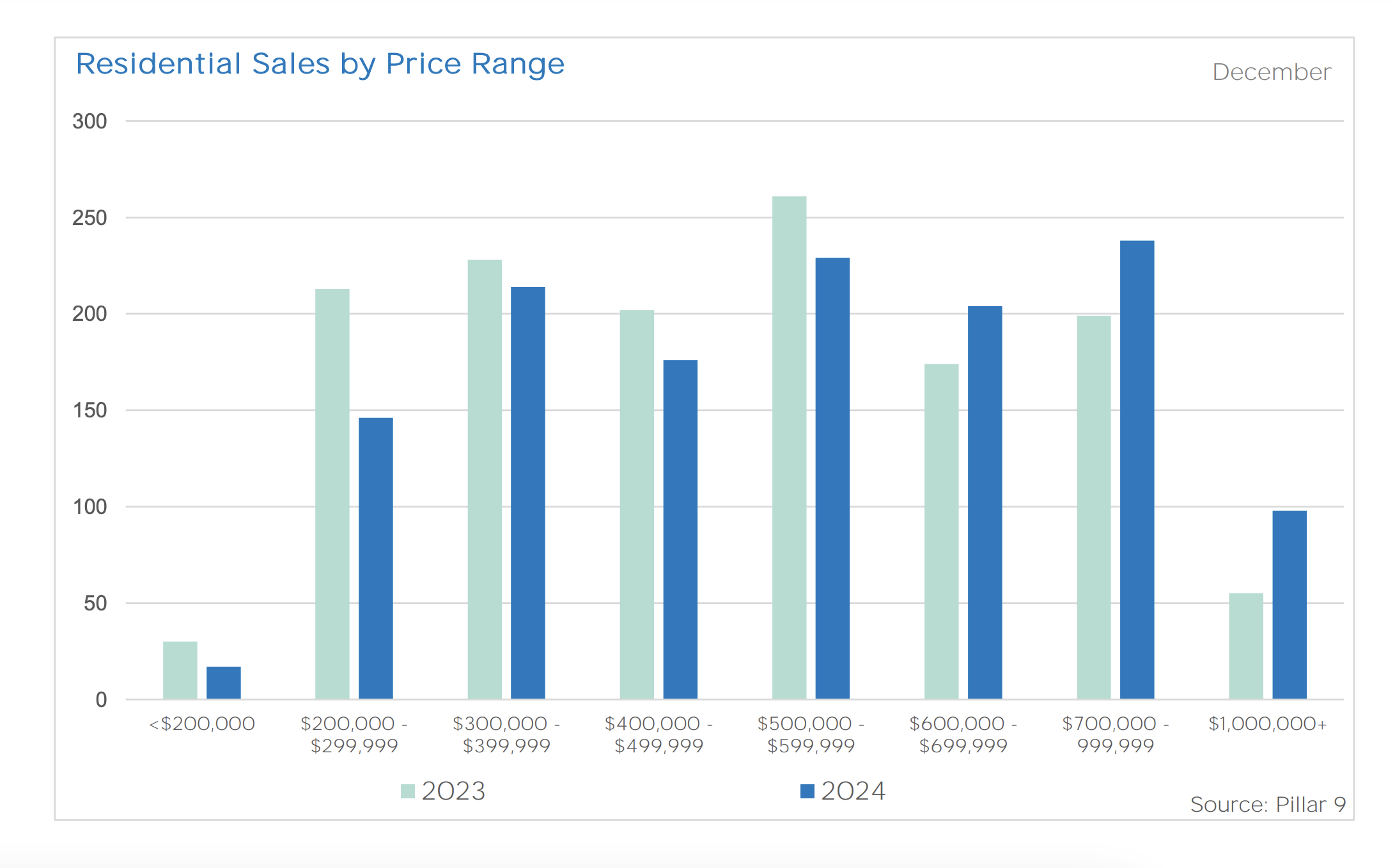
While inventory may be higher overall, it’s largely composed of higher-priced homes. Gone are the days of picking up a 2-bedroom condo for under $300,000. That $300,000 condo you bought just two years ago? It’s now worth around $380,000. As a result, many properties in the $300,000 range are being snatched up quickly, or no longer exist.
In the single-family home market, we’re seeing more homes available for $900,000+, while the $500,000-$800,000 range is becoming increasingly scarce. This may give the illusion that the market is slowing down, but the more affordable homes — by Calgary standards — are still competitive. These homes are still selling fast, sometimes without conditions and often above asking price.
In 2023 we saw apartment prices recover to similar levels as the 2014 boom. And in 2024, they increased another 15%. Please note this is a statistical comparison and not every condo building is priced above its 2014 values.
Why the slowdown in the second half of the year? Well, a few reasons may have contributed. First, net migration wasn’t as high as 2023. In Q3, net migration was 32% lower than in 2023, although it still remained well above the historic average.
Rental rates also eased slightly in 2024 after a hectic 2023. This has allowed renters more breathing room and less pressure to buy, which has helped ease some demand. According to CMHC, the average rent for a 2-bedroom apartment in Calgary was $1,571 in October 2023—an increase of 14% from 2022. In October 2024, that rose to $1,732, an 8% increase from 2023.
Additionally, the Bank of Canada has cut rates by 1.75% since June, with more cuts expected in 2025. Lower rates may have some buyers sitting tight in anticipation of even better borrowing conditions mixed with (hopefully) more inventory to choose from.
Lastly, October to December tend to be the slowest months for real estate with the fewest sales. So, piling that in with the other factors and the uncertainty surrounding elections and economic conditions, it’s not a huge surprise to see a bit of a slow down in market activity.

The predictions for 2024 had some interesting results. Here’s a comparison of the projected (Calgary Real Estate Board 2024 forecast) and actual increases in all property types:
- Detached Houses: Predicted 4% increase → Actual 10.8% increase. Despite their higher price point, detached homes made up 37% of total sales in 2024.
- Semi-Detached: Predicted 5.5% increase → Actual 10.9% increase.
- Townhomes: Predicted 9% increase → Actual 14.2% increase.
- Apartments: Predicted 9.5% increase → Actual 15% increase.
It’s important to note that these statistics reflect all of Calgary. Some neighbourhoods have seen more or less growth than others. For example, townhome prices rose across all districts, but the increase ranged from 12% in the city centre to over 20% in more affordable areas like the Northeast and East.
If you’re curious about how your neighbourhood performed, feel free to reach out. We are happy to provide tailored insights and discuss what’s happening in your area.
As we look toward 2025, I expect another strong year for Calgary real estate. Our team worked with almost 100 clients this year, and we anticipate a similar number of transactions in 2025. If this trend holds across the industry, we’re likely to see another year of competing offers and high demand.
And stay tuned for our next blog after Amie, Madison, and I attend the 2025 CREB Forecast later this month. We’ll be diving into what the experts are predicting for the year ahead!
- Parker